

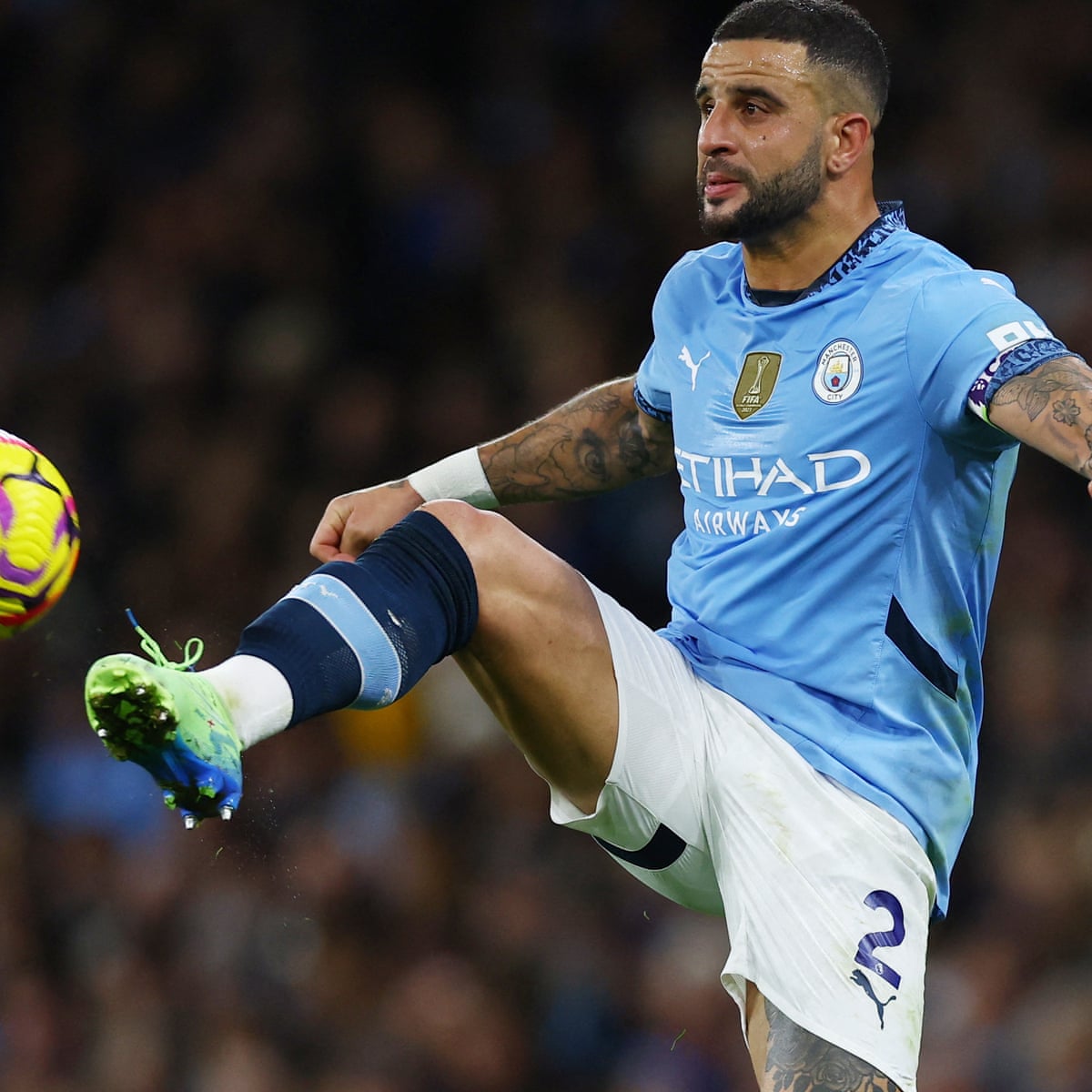
Kyle Walker won six Premier League titles at Manchester City under Pep Guardiola, becoming an integral part of one of the most dominant English teams of all time in the process—but the England hero has revealed that his Spanish boss borrowed crucial defensive principles from Jose Mourinho’s legendary Chelsea sides to bring those championships home to the Etihad Stadium. This candid admission from one of Guardiola’s most trusted lieutenants provides fascinating insight into the tactical evolution of Manchester City’s dynasty and challenges common perceptions about Guardiola’s purely attack-minded football philosophy.
Pep Guardiola joined Manchester City in 2016, arriving with an already stellar reputation having won every trophy available to him at both Barcelona and Bayern Munich. The Spanish tactician was universally recognized as one of football’s great innovators, a pioneer of possession-heavy, aesthetically pleasing football that dominated European football throughout the previous decade. His Barcelona team that won the 2009 and 2011 Champions League titles is widely considered one of the greatest club sides ever assembled, playing a mesmerizing brand of tiki-taka football that left opponents chasing shadows.
It’s been an extraordinarily successful ride for Manchester City since Guardiola’s appointment. Six Premier League titles in eight seasons, two FA Cup trophies, four consecutive Carabao Cup medals, and the crowning achievement—a Champions League triumph in 2023—have propelled Guardiola to legend status at the Etihad Stadium and cemented this Manchester City team’s place among English football’s all-time greats. The numbers are staggering: over 100 points accumulated in the 2017-18 season, 98 goals scored in that same campaign, and a level of domestic dominance that only Sir Alex Ferguson’s Manchester United have previously achieved in the Premier League era.
But despite being universally recognized as a pioneer for possession-heavy, attacking football in England—a manager whose teams regularly score over 90 goals per season and dominate territorial possession by margins of 65-70%—former Manchester City star Kyle Walker has admitted that Guardiola’s all-conquering side took crucial inspiration from Jose Mourinho’s defensive principles to bring home their unprecedented success. This revelation challenges the popular narrative that Guardiola’s success stems purely from attacking excellence and reveals a more nuanced tactical approach that balanced offensive brilliance with defensive solidity.
Walker left Manchester City in January 2025 to join Premier League relegation battlers Burnley, ending an eight-year affiliation at the club that had seen him establish himself as arguably the finest right-back of his generation. His departure was acrimonious, occurring mid-season in circumstances that clearly frustrated Guardiola, but it also freed Walker to speak more openly about the tactical secrets behind City’s success than he might have done while still on the club’s payroll.
Speaking to the Premier League’s official YouTube channel, the England right-back stated that his former boss specifically took inspiration from Jose Mourinho’s extraordinarily sturdy Chelsea teams from 2004-05 and 2005-06—sides that provided both defensive excellence and ruthless attacking efficiency during a four-year period of sustained dominance that delivered back-to-back Premier League titles and established the blueprint for success that subsequent champions would attempt to replicate.
“As a foundation to ever win any Premier League [title], I think Chelsea probably set the record with the most clean sheets, back when [Jose] Mourinho was doing it,” Walker explained, immediately highlighting the defensive foundation that underpinned Mourinho’s success at Stamford Bridge. “As players, we always kind of looked at that. We thought ‘okay, to build a solid foundation to go and win the Premier League, you need a good defence’. And we pride ourselves off that. It didn’t matter who played or started as the manager liked to rotate his team around a lot. We always prided ourselves on the defensive unit, that we’re going to keep clean sheets, and that we know we had attacking people in the team that will go and score you goals.”
This admission is significant because it reveals that Manchester City’s players—and by extension, their coaching staff led by Guardiola—specifically studied Mourinho’s Chelsea as the exemplar of Premier League success. Rather than viewing Mourinho’s approach as antithetical to their own possession-based philosophy, City recognized that the Portuguese manager had identified a fundamental truth about winning English titles: defensive solidity provides the platform upon which attacking excellence can flourish.
To understand why Manchester City’s players looked to Mourinho’s Chelsea as their defensive inspiration, one must examine the extraordinary statistics from that 2004-05 Premier League season—numbers that remain unmatched nearly two decades later and which represent perhaps the greatest defensive campaign in English top-flight history.
Chelsea conceded just 15 goals across the entire 38-game Premier League season, losing only once all campaign in a 1-0 defeat to Manchester City at the City of Manchester Stadium in October 2004. To put this achievement in context, no team before or since has come remotely close to matching this defensive excellence in the Premier League era. Arsenal’s famous 1998-99 season saw them concede 17 goals—impressive but still two more than Mourinho’s Chelsea. Manchester United’s 2007-08 title-winning campaign featured 22 goals conceded, while Chelsea themselves “only” managed 22 the following season despite winning the league again.
The statistics from that season are almost absurd in their dominance. Chelsea accumulated 25 clean sheets from 38 matches, meaning they prevented the opposition from scoring in nearly two-thirds of their games. They enjoyed an incredible run of 10 consecutive matches from mid-December to early March during which goalkeeper Petr Cech did not concede a single goal—over 1,000 minutes of football without being beaten. At Stamford Bridge, they went the entire season unbeaten, creating a fortress mentality that made their home ground genuinely intimidating for visiting teams.
The defensive unit that Mourinho assembled featured players who would become legends of English football. Petr Cech, the Czech goalkeeper who arrived from Rennes, proved to be one of the finest shot-stoppers in Premier League history. John Terry and Ricardo Carvalho formed a center-back partnership that combined Terry’s aerial dominance and leadership with Carvalho’s technical quality and reading of the game. Full-backs Paulo Ferreira and William Gallas (later replaced by Ashley Cole) provided defensive reliability while contributing to attacks when opportunities arose.
In front of them, Claude Makélélé revolutionized the defensive midfield position to such an extent that the role became colloquially known as the “Makélélé role” throughout football. The French midfielder’s positional discipline, tireless work rate, and ability to break up opposition attacks before they developed provided the foundation that allowed more creative players like Frank Lampard, Joe Cole, and Arjen Robben to express themselves further forward without worrying about defensive responsibilities.
When Pep Guardiola arrived at Manchester City in 2016, he brought with him a tactical philosophy forged during his time at Barcelona and refined at Bayern Munich. His approach emphasized possession dominance (typically 65-70% in most matches), building attacks patiently from the goalkeeper and center-backs, aggressive pressing to win the ball back quickly after losing it, and creating overloads in attacking areas through intelligent positioning and movement.
This philosophy produced stunning attacking football at both Barcelona and Bayern, with his teams regularly scoring over 100 goals per season across all competitions. However, Guardiola’s early experiences in England revealed that pure attacking excellence without defensive solidity would not suffice in the Premier League’s uniquely demanding environment. His debut season saw City finish third despite scoring 80 league goals, hampered by defensive vulnerabilities that cost them points in crucial matches.
The revelation from Kyle Walker that City specifically studied and incorporated Mourinho’s defensive principles explains the tactical evolution that occurred during Guardiola’s second and third seasons at Manchester City—the campaigns that delivered the 2017-18 centurion season (100 points) and the 2018-19 domestic treble. While maintaining their attacking prowess, City developed a defensive solidity that had been absent during Guardiola’s first year.
The numbers tell the story. In 2017-18, Manchester City conceded just 27 Premier League goals while scoring 106—a goal difference of +79 that demonstrated their ability to dominate at both ends of the pitch. The following season, despite an intense title race with Liverpool that went to the final day, City conceded only 23 goals. These totals, while not matching Mourinho’s Chelsea, represented vast improvement from the 39 goals conceded in Guardiola’s debut campaign and placed City among the Premier League’s elite defensive units.
Walker himself was central to this defensive transformation. Guardiola identified the England international as the perfect full-back for his system—someone with the pace to recover against counter-attacks, the tactical intelligence to tuck inside and form a back three when City had possession, and the technical quality to contribute to build-up play from the back. Walker’s signing from Tottenham for £50 million in summer 2017 was one of several defensive investments that summer, alongside Danilo, Kyle Walker, Benjamin Mendy, and Ederson.
What made Manchester City’s success under Guardiola so remarkable was not simply copying Mourinho’s defensive approach wholesale, but rather synthesizing defensive pragmatism with attacking excellence to create a hybrid style that incorporated the best elements of both philosophies. This represents the kind of tactical evolution that separates good managers from great ones—the willingness to learn from rivals and adapt philosophies based on evidence rather than dogma.
Guardiola’s implementation of Mourinho’s defensive principles occurred in several key areas:
Defensive Organization: Like Mourinho’s Chelsea, City developed a disciplined defensive shape that made them difficult to break down even when dominating possession. When attacks broke down, players immediately transitioned into defensive positions, maintaining structural integrity rather than being caught disorganized.
Clean Sheet Mentality: Walker’s comments about pride in defensive performance regardless of rotation reflected a cultural shift within the squad. Clean sheets became celebrated achievements, with defenders and defensive midfielders receiving equal praise to goal-scorers for their contributions to victories.
Goalkeeping Excellence: Just as Petr Cech was crucial to Chelsea’s defensive success, Ederson’s arrival from Benfica provided City with a world-class goalkeeper whose shot-stopping ability was matched by his distribution skills. Ederson recorded 20 clean sheets in his debut Premier League season, directly contributing to City’s defensive improvement.
Tactical Flexibility: While maintaining possession-based principles, Guardiola showed willingness to adopt more pragmatic approaches in crucial matches, particularly in Champions League knockout ties. This flexibility—previously seen as a weakness in his management—improved significantly during his time at City.
Kyle Walker’s eight-year tenure at Manchester City will be remembered as one of the most successful periods any English player has enjoyed at club level. His six Premier League titles equal the record for English players, while his contributions to City’s treble-winning 2022-23 season cemented his status as a club legend despite the acrimonious nature of his eventual departure.
During his time at the Etihad, Walker made over 280 appearances across all competitions, providing defensive reliability and attacking thrust in equal measure. His recovery pace became legendary, allowing City to play with an aggressive high line secure in the knowledge that Walker could recover against pacey forwards attempting to exploit space in behind. His partnership with Kevin De Bruyne down City’s right flank produced countless assists and goals, with Walker’s overlapping runs stretching defenses and creating space for City’s creative players to operate.
Statistically, Walker’s defensive numbers during City’s most successful seasons were exceptional. In the 2017-18 centurion campaign, he registered 11 assists while maintaining defensive solidity that helped City keep 18 clean sheets. His performances earned him PFA Team of the Year recognition and established him as the Premier League’s finest right-back of his generation.
However, Walker’s final years at City were complicated by declining physical capabilities and increasing criticism for defensive errors in high-profile matches. His performances in the 2023 FA Cup final and several Champions League fixtures drew scrutiny, with some suggesting his legs had gone and that City needed to replace him. The psychological toll of feeling like “the excuse” whenever results went wrong eventually contributed to his mid-season departure—a decision he admitted was “selfish” but ultimately necessary for his mental wellbeing.
Everyone in world football recognizes Pep Guardiola’s attacking football as supremely entertaining to watch, with his managerial trophy cabinet standing as testament to its effectiveness. But Jose Mourinho’s defensive setup at Chelsea during the 2004-05 season represents an achievement that goes beyond anything Guardiola has matched from a pure defensive perspective, and which may genuinely never be surpassed given modern football’s increased emphasis on attacking football.
The table below illustrates how Mourinho’s Chelsea defensive record compares to other legendary Premier League campaigns:
| Team and Season | Premier League Goals Conceded | League Position |
|---|---|---|
| Chelsea, 2004-05 | 15 | 1st |
| Arsenal, 1998-99 | 17 | 2nd |
| Chelsea, 2005-06 | 22 | 1st |
| Manchester United, 2007-08 | 22 | 1st |
| Manchester City, 2017-18 | 27 | 1st |
| Liverpool, 2018-19 | 22 | 2nd |
The 15 goals conceded represents the Premier League era’s gold standard for defensive excellence, a benchmark that has stood for two decades despite numerous excellent defensive teams attempting to match it. The context makes this achievement even more impressive—Chelsea accomplished this while also scoring 72 goals, demonstrating that their defensive solidity did not come at the expense of attacking potency.
Teams can certainly score plenty of goals without winning titles, as demonstrated by Liverpool’s 101 goals in the 2013-14 season under Brendan Rodgers. However, they conceded 50 goals that campaign, and that defensive fragility ultimately handed Manchester City their second Premier League title as Liverpool’s title challenge collapsed in the final weeks. This perfectly illustrates Walker’s point about defensive foundations being essential to championship success—attacking brilliance alone rarely suffices without defensive reliability.
Despite Walker’s revelation about Manchester City studying Mourinho’s defensive principles, fundamental philosophical differences separate these two managerial giants. Understanding these differences provides context for appreciating how Guardiola adapted specific defensive elements while maintaining his overall attacking philosophy.
Mourinho’s approach emphasizes tactical discipline, defensive organization, and pragmatic adaptation to specific opponents. His teams traditionally sit deeper, absorb pressure, and look to exploit spaces left by attacking opponents through rapid counter-attacks led by pacey forwards. This approach proved devastatingly effective at Porto, Chelsea, Inter Milan, and Real Madrid, delivering Champions League titles at three different clubs and league titles in four different countries.
Guardiola’s philosophy, by contrast, emphasizes controlling matches through possession dominance, high pressing to win the ball back quickly, building attacks patiently from defense, and creating overloads in attacking areas through intelligent positioning. His teams aim to suffocate opponents by monopolizing possession (often exceeding 70% in matches) and pinning them back in their own defensive third through sustained attacking pressure.
These contrasting approaches have produced one of football’s great rivalries, spanning confrontations in Spain (Barcelona vs Real Madrid), Germany (Bayern Munich vs various opponents), and England (Manchester City vs Manchester United, Chelsea, and Tottenham). Their head-to-head record across all competitions is remarkably balanced, with neither manager holding a decisive advantage, though Guardiola’s superior trophy haul overall reflects his longer periods at elite clubs with superior resources.
The revelation that even Pep Guardiola—football’s great attacking idealist—recognized the necessity of incorporating Mourinho’s defensive principles reflects broader evolution in elite football tactics. Modern championship-winning teams almost universally combine attacking potency with defensive solidity, recognizing that sustained success requires excellence at both ends of the pitch.
Liverpool’s Champions League and Premier League triumphs under Jurgen Klopp demonstrated this perfectly. While Klopp’s gegenpressing philosophy emphasized attacking intensity and rapid transitions, the signings of Virgil van Dijk and Alisson Becker transformed Liverpool from an exciting but defensively vulnerable team into complete champions. Van Dijk’s arrival particularly shifted Liverpool’s defensive record dramatically—they conceded just 22 goals in their 2018-19 title-challenging season and 33 in their championship campaign, providing the platform for Mohamed Salah, Sadio Mané, and Roberto Firmino to flourish.
Similarly, Chelsea’s recent successes under Thomas Tuchel were built on defensive excellence that recalled Mourinho’s earlier triumphs. Tuchel’s switch to a back three system immediately improved Chelsea’s defensive record, with the team conceding just two goals in their run to the 2021 Champions League final. This tactical pragmatism—prioritizing defensive solidity when necessary—enabled Chelsea to defeat Manchester City in that final despite being underdogs.
Kyle Walker’s move to Burnley in January 2025 initially seemed surprising given the club’s precarious Premier League position and his previous status as a Manchester City legend earning substantial wages at one of world football’s richest clubs. However, the transfer has proven beneficial for all parties, with Walker rediscovering his best form while Burnley benefit from his experience and leadership.
At Burnley, Walker has become exactly the kind of experienced defender that Vincent Kompany’s relegated Burnley team lacked during their previous Premier League campaign. His presence provides stability, organization, and leadership that younger players can learn from—qualities that prove invaluable for teams fighting relegation battles where mental strength often matters as much as technical ability.
Walker’s admission about Manchester City studying Mourinho’s defensive principles also reveals his analytical understanding of football tactics that extends beyond simply executing instructions on the pitch. His recognition of what made Manchester City successful—combining Mourinho’s defensive solidity with Guardiola’s attacking brilliance—demonstrates tactical intelligence that should serve him well whether he pursues coaching after retirement or simply sees out his playing days at Burnley.
Kyle Walker’s revelation that Pep Guardiola specifically instructed Manchester City’s players to study and emulate Jose Mourinho’s Chelsea defensive record provides fascinating insight into the tactical evolution that transformed City from exciting nearly-men into England’s most dominant team. It challenges simplistic narratives about these managers representing opposite poles of football philosophy, revealing instead that the greatest managers learn from rivals and synthesize the best elements of contrasting approaches.
Mourinho’s 2004-05 Chelsea team set a defensive standard that remains unmatched two decades later—15 goals conceded across an entire Premier League season represents an achievement that may genuinely never be surpassed given modern football’s increasing emphasis on attacking entertainment. That defensive excellence provided the foundation for sustained success, delivering back-to-back titles and establishing Chelsea as a European powerhouse.
Guardiola’s willingness to learn from this example while maintaining his attacking principles demonstrates the flexibility and tactical intelligence that separates good managers from all-time greats. By combining Mourinho’s defensive solidity with his own possession-based attacking philosophy, Guardiola created a Manchester City team that dominated English football for half a decade, accumulating six Premier League titles and finally conquering Europe with the 2023 Champions League triumph.
For Kyle Walker, his eight years at Manchester City delivered success beyond most players’ wildest dreams—six league titles, domestic cups, and a Champions League medal. His candid admission about the tactical secrets behind that success reveals a player who understood not just how to execute instructions but why those instructions worked. Whether at Burnley or wherever his career ultimately concludes, Walker’s legacy as one of English football’s finest defenders is secure, built on foundations that even Pep Guardiola recognized came from studying Jose Mourinho’s defensive masterclass.


